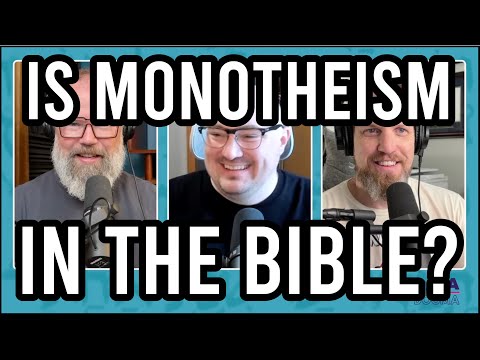
Is the Trinity Biblical?
This episode, we're going after the Trinity. Where did the concept of a triune God come from? Is it in the Bible? If not, is it at least the best solution to the problem it was trying to solve? How did the idea become canon? Are we finally going to talk about something that actually happened at the Council of Nicaea? ---- For early access to an ad-free version of every episode of Data Over Dogma, exclusive content, and the opportunity to support our work, please consider becoming a monthly patron at: https://www.patreon.com/DataOverDogma Follow us on the various social media places: https://www.facebook.com/DataOverDogmaPod https://www.twitter.com/data_over_dogma Have you ordered Dan McClellan's New York Times bestselling book The Bible Says So yet??? Buy at this link: https://static.macmillan.com/static/smp/bible-says-so-9781250347466/
Bonus Episode Recorded with this episode: read the full transcript $10 patrons · log in with Patreon Watch on YouTube
 Apple Podcasts
 Spotify
Transcript — tap any word to jump the video there
Dan McClellan And that's where they came up with what's called the hypostatic union, where Jesus is 100% God, but Jesus is 100% human. How does that work? Shut up. Doesn't make a ton of sense. It makes enough sense that we can threaten people if they don't agree with it. And so it is the, the institution of the church is the only reason that the concept of the Trinity survived, because without the Roman Empire and all of the might and the coercion and the force behind it, it would've gone the way of the dodo long, long ago. Hey, everybody. I'm Dan McClellan. And
Dan Beecher I'm Dan Beecher.
Dan McClellan And you are listening to the Data Over Dogma podcast, where we increase public access to the academic study of the Bible and religion and combat the spread of misinformation about the same. How are things, Dan?
Dan Beecher Rocking and rolling, man. Uh, I think this is-- We're, we're, we're delving into one that's gonna be, uh, a, a powder keg.
Dan McClellan Yeah. Yeah.
Dan Beecher We're getting, we're getting, we're getting into the good stuff here. So Dan.
Dan McClellan Yes.
Dan Beecher We've got this concept of the Trinity. You keep referring to it.
Dan McClellan Mm-hmm.
Dan Beecher What is it? What are we talking about? Why is it-- Why, why have we... I mean, it-- I-- It's not in the Bible itself, right?
Dan McClellan No. It's not in the Bible. We don't have,
Dan Beecher we don't have the word Trinity. We don't have any word or even any concept presented that is like what is now believed and understood-- believed as and understood to be the Trinity. Right.
Dan McClellan My, my argument is that the conceptual package of the Trinity, the framework of the Trinity, develops between the second and the fifth centuries CE. We get our, our, our most-- our kind of main articulation of the doctrine of the Trinity at the Council of Nicaea in 325 CE. And that is where there is a debate over whether or not Jesus, uh, whether or not there was a time when Jesus didn't exist, and, uh, whether or not Jesus is subordinate to the Father or equal to the Father. And Arius, uh, is basically defeated. Uh, and we sign the, the Nicene Creed, which argues that, uh, this concept-- for this concept of consubstantiality. And this is the first time that Christians actually assert this notion of consubstantiality as a whole. The idea being that the Trinity is-- comprises three different persons within the one being that is God. And, uh, we'll, we'll get into a little more detail about that in a moment, but the whole reason this develops is because we've got this New Testament that seems to be treating Jesus as having some kind of special relationship with God, but also seems to be distinguishing Jesus from God. And we just finished talking about the Gospel of John, which is coming really, really close to saying Jesus is God without actually having Jesus come out and say it. But then now that the New Testament has come together, we now have to consider all these other texts, all Paul's texts. We gotta look at the Gospel of Mark. We gotta look at all these other texts, and we've gotta create a unifying framework that makes all of them work together. So how can Jesus be all of these things at the same time? And we've gotta come up with a framework that is philosophically defensible, uh, to the Greco-Roman intelligentsia. Because in this time period, uh, a group of Christians, the, the educated Christians, uh, w- we now refer to them, uh, as apologists, are trying to kind of spread the gospel among the more educated, uh, Greco-Roman populations, and they need to make it palatable to folks who are educated in, uh, Middle and then, uh, later Neoplatonic thought, in Stoicism, in Pythagoreanism, in Epicureanism. And there's kind of this, um... There are a bunch of different ways people are going about trying to, um, intellectualize the gospel, which requires this unifying framework. So we have people talking about, "Well, Jesus seems to be God, but let's figure out how." And, um, in the previous segment, I, I mentioned that Philo identifies the Logos as a second God. We also have Justin Martyr, one of the early apologists, uh, who's writing r- right in the middle of the second century CE, right around 150 CE, who also refers to Jesus as the Logos, as another God. And so i- in the earliest periods, we're still kind of, um, trying to figure out how to, to make this work, and we're using a bunch of different ideas. By the end of the second century, we've got this, this word Trinity, but we're, we're not exactly sure how to fill it out. Uh, it's a little kid in a big oversized suit coat. It just, it's not, uh, you know... He's not able to walk without tripping over himself yet. Um, and so what happens is, is we just have a bunch of people in, in texts that they're writing where they're, they're engaging in this kind of dialectic back and forth with imaginary opponents. Sometimes they're, they're real opponents, but usually it's, um, imaginary opponents, or they're at least representing the arguments of real opponents, but probably not in perfectly accurate ways.
Dan Beecher Right.
Dan McClellan Trying to consolidate all these things and trying to use Greco-Roman philosophical frameworks to make it all fit together. And the main principles we have are, well, we got these three people. We got God, we got Jesus, and we got the Holy Ghost. Now, the Holy Ghost is, is kind of an outlier, an afterthought. This is just somebody that's like, "Don't forget the Holy Ghost." And so people are like, "Oh, God. Okay. The Holy Ghost too." Um-
Dan Beecher Yeah, we may have to do a show about the Holy Ghost, 'cause I am very confused- ... about who and/or what that is.
Dan McClellan And is, and is different from text to text exactly what the Holy Ghost is. But yeah, I think that would be, that would be a fun show to do. Um, and so- Some of the things that, that develop are, are concerns for, well, one, how many gods are there? Uh, and, and pretty quickly it's like, well, we, we can only recognize one, uh, highest god. And so w- you know, we can recognize demons, and we can recognize angels and all of these things, but we don't wanna call them gods. Uh, they are subordinate, they are contingent, so, uh, they don't deserve that title. And so pretty quickly they decided, well, because Judaism is well-known as kind of the, uh, the only one god religion, and this is one god rhetoric, this is not monotheism as we understand it- Right ... today, we, we should find a way to make Jesus and God one God, whether it's through this emanation idea, whether it's through some other concept. And, um, and we get this, um, this bishop in Alexandria named, uh, Arius, who is looking at the New Testament and says it's very clear that Jesus is subordinate to God, and that Jesus is a creation of God, which means that there was a time when Jesus didn't exist, and then God created Jesus. And this was actually pretty standard in the 3rd century CE, but by the 4th century CE, we're exalting Jesus more and more. Mm. And so it begins to become problematic to say Jesus, there was a time when Jesus didn't exist and, and that Jesus is subordinate. Because one of the main two features of, of deity is, one, that it is eternal, it has always existed, and two, that there is no change, there is no hierarchy, there is no alteration in deity. It is always the same, and it can never change. And so it was undermining the attempt to make the gospel palatable to Greco-Roman intelligentsia if their concept was flatly contradicting the received wisdom of Greek philosophy. And so by the beginning of the 4th century, that's a problem. We call the Council of Nicaea. We get a bunch of bishops together. There are different accounts of how many bishops were there, but in short, uh, Arius and a couple of his buddies are in the minority. They get overruled. Uh, they get slapped around. Literally, this is where Saint Nicholas is supposed to have slapped, uh, Arius. Um- Oh, Santa Claus- Yeah. ... calm down. Um, we're giving out gifts and punching heretics, and, and we're all out of gifts. Um- So there's, there's an account that suggests that, that, uh, Constantine, who was the, the Roman emperor who has convened the Council of Nicaea, basically he wants his kids to stop fighting.
Dan Beecher Right.
Dan McClellan So he's calling a family meeting, and he's just like, "I don't care what you figure out. Figure it out." And so-
Dan Beecher And sorry. I- you, you mentioned the guys... Who were the guys that, uh, Nicholas slapped?
Dan McClellan Arius.
Dan Beecher The, the... Arius. And, and what was Arius's position on the-
Dan McClellan He, he was the one saying that, one, Jesus was subordinate to God the Father- Okay ... and two, there was a time when Jesus did not exist. And up until around, uh, the beginning of the 4th century CE, uh, pretty much everybody would've agreed with him to, to one degree or another. But now it was becoming increasingly problematic. So the majority of bishops were like, "No, no, they're, um, they're the same." And you get the hammering out of this concept of homoousios, which is translated as consubstantiality. Basically, the idea is they are equal and co-eternal because they are all of the same substance.
Dan Beecher Right.
Dan McClellan And so you can't divide the substance, but you also can't confuse the persons. And so when, when we think of a person today, we think of a being who a- also has a psychological unity, a single psychological identity. And what they did was basically divide the idea of the psychological identity and the being and say, now that they're different and one is subordinate... Or m- maybe not subordinate. Maybe that's a bad word. But one is internal to the other. We can have multiple psychological identities inhabiting the one s- being, the one substantial being. Um, and so th- this was a, a philosophical way of making this all work, and it was, uh, literally imperial might that kept it together. Mm. 'Cause Constantine then said, "Okay, everybody sign on the dotted line, or you get exiled." And there's a story that one of the bishops came up and really quickly added a little iota to make it, uh, homoiousios, uh, which would be of like substance rather than of the same substance, uh, and then, you know, banished. Um- Yeah. And so Arius-
Dan Beecher You can't just, you can't just sneak in a letter.
Dan McClellan Yeah, yeah. It's-
Dan Beecher Come on. We all know.
Dan McClellan They tried. No, there's n- we don't know if, if Santa Claus punched him, too, but- But Arius gets-
Dan Beecher Oh, we know. We know. He punched him.
Dan McClellan But Arius gets exiled and, um, and this becomes the Nicene Creed. And then we have another controversy that pops up that is settled a century later in the Council of Chalcedon, and that controversy was, "Okay, Jesus is God, but Jesus was also a human. How's that work? Is it 50/50?" And, and that's where they came up with, uh, the, what's called the hypostatic union, where Jesus is 100% God, but Jesus is 100% human. How does that work? Shut up. Yeah. It's, it's a mystery. We're not... It's, it just is the way it is. And, and what you see in, in these arguments is basically- We just need to make it work, and so we just need to come up with an argument that is plausible enough that everybody can be like, "Yeah, I c- I can get on board with that." "Okay, then get on board with it. Sign right here. Okay, anybody you see saying anything else, you report them to us. We're gonna exile them, and we're gonna use the empire to enforce this new philosophical framework. Doesn't make a ton of sense. It makes enough sense that we can threaten people if they don't agree with it." And so it is the, the institution of the church is the only reason that the concept of the Trinity survived, because without the Roman Empire and all of the might and the coercion and the force behind it, uh, it would've gone the way of the dodo long, long ago.
Dan Beecher I'm just... You know, one of the questions that comes up for me is did that era, Greco-Roman period, did everything have to be more, uh, s- solid? Did they not have figurative ideas? 'Cause it seems like, you know, in our, our first segment, we're talking about John, you know, in John, we're talking about Jesus using figurative ideas or, you know- Yeah ... ideas of, "I am God," in the way that, like, God is me and you all could be God, and, like, we're all, you know, we're all gonna be part of God, or we're gonna be in God- Right ... and God's gonna be- Yeah ... in us. And, like, he's using language that makes perfect sense to me if we're thinking figuratively. Yeah. And there's no reason why we can't think figuratively about it. It makes sense. Like, throughout the Bible, there's figurative language all the time. Yeah. Did something get more literal in the, uh, in the fourth century or something?
Dan McClellan So what happened is the church became part of a powerful institution that had oversight over the entire population. And suddenly, the ideas that resonated with different groups and everybody just kind of was drawn to the group or the idea that resonated with them, you now had a powerful social institution that needed to harmonize things and needed everything to work together in order to be able to establish boundaries and in order to be able to say, "This one's in. This one's out." Uh, because boundary maintenance becomes monumentally important in a s- in a circumstance like that, where you are-- there's a very strong in-group and you are opposed to the out-group, and you wanna make sure that you know who is who. And so it had to be systematized. It all has to be reduced to something that, uh, that we can, uh, draw lines around- Yeah ... in a very simple binary way. And so yeah, that's exactly what happened, is initially you had your Marcan folks who were like, "Yeah, Jesus is really human-like, and Jesus is doing this and that," and, and, um, you know, the Messianic secret, yay. And then you had your Lukes, and then you had your, uh, Matthews, who were the Judaizers, who was like, "The Law of Moses, man. Yeah, we gotta keep it." And, and you had your Johns, who were their own, uh, little group of people. And everybody was just happy doing their own thing. But when you all bring it-- when you bring them all together and you say, "This is now one book," we need-- Then-- And there's a social institution that is, um, has authority over all the people who are associated with this one book. Suddenly, they're not gonna allow them to operate, you know, function in their own little corners of this thing. We need to bring it all together. We need unity. And that's precisely what Constantine was doing, is saying, "There's too much disunity. I don't care how you fix it. Just fix it." And so that is imposing that unifying framework which results in, well, Greek philosophical ideas are gonna be the most efficient and effective means of doing this. Let's come up with Greek philosophical ideas that are going to allow us to say all the texts, uh, fit together, uh, and here's what they are all-- they're all pointing in the same direction, and here's the thing that they're pointing at, and don't ask how it works because we're just gonna exile you.
Dan Beecher Yeah.
Dan McClellan Um, and so it is, it is, um, institutional pressure, imperialism, that is the reason that the Trinity survived in the way it has. But-- And, and the, the thing that a lot of people refuse to acknowledge is the Trinity is the result of that systematization, that unifying framework. Prior to the unifying framework, when the texts were written, there was no Trinity because no one was forced to try to reduce it to a single conceptual framework. Everyone was allowed to let it work whatever way resonated with them. And so the author of John had no concept of Jesus as God in anything remotely approximating the way the Trinity would later shake out, uh, which is why, uh, I just-- you can't say that Jesus is God in, in the Gospel of John, at least in no way, shape, or form like the way you say Jesus is God in the Trinity.
Dan Beecher Yeah. You know, as an outsider, as a non-believer in this, I look at it and I just don't see the problem, you know? I, I feel like God-- I feel like Jesus invoking God, or like you like to say, you know, sort of housing God's name or, or, or, you know, housing God's authority-
Dan McClellan Mm-hmm
Dan Beecher ... in himself seems plenty to me. Like, this can be a being that has divinity, you know, sort of instilled in him by virtue of his, uh, authority, his title, his, uh, his, his sort of provenance. But, like, it doesn't feel problematic to me-
Dan McClellan Yeah
Dan Beecher ... looking at it for it to be-- for, for, for him not to be God ... himself.
Dan McClellan Yeah.
Dan Beecher You know what I mean? It feels actually more problematic for him- Mm-hmm ... to be God. Like, that feels-
Dan McClellan Yeah
Dan Beecher ... wildly problematic. You've created so many more problems than you've solved.
Dan McClellan Yeah, and, uh, and I, I feel the same way. That's, that's probably exactly how it happened, is you had a lot of people who were like, "Oh yeah, that's totally intuitive. I get it." And then somebody was like, "Nah, doesn't work for me." But then once you have the two of them as part of the same institution, and the institution's like, "Agree" Then you gotta, you gotta figure out a way to, um, to agree, which always, i- which, uh, has one of two ways of working. One per- one defeats the other, or you create a new third thing-
Dan Beecher Right
Dan McClellan ... that tries to reconcile the two.
Dan Beecher Yeah.
Dan McClellan And that's what happened. We created the new third thing-
Dan Beecher It's both
Dan McClellan ... which was the Trinity. Yeah. And, um, and Greek philosophy was the wa- And, and it was also, they were also arguing with the philosophers and the Gnostics and others, and, and this is how a lot of the doctrines of earlier, early Christianity developed, was Greek philosophers, philosophers were like, "Pfft, the resurrection? But flesh can't be eternal. Flesh is changing. Flesh is, uh... Or it can't be divine. Flesh is-"
Dan Beecher Right.
Dan McClellan Um, it's co-eternal. The material world has always been there, but it's not divine. Uh, why would you even want back a body that, that decomposed, that was lost at sea, that maybe was eaten by an animal and passed through its digestive system? Why would you want that body back? They were like, "This is weird, guys. What are you doing?" And they had to be like, "Well, n- look... Okay. No. Um, all mat- the material world is contingent upon God. God created it out of nothing. Yeah, that's, that's what happened." And, and then they came up with an argument that was like, "Okay, that's different. That's new. I see where you're going. I want to sign up for your newsletter." Um, and so the, the idea of creation out of nothing was an invention of the late second century CE. In fact, we can say it was between 170 and 180 CE that we created the doctrine of creation out of nothing in order to respond to criticisms from Greek philosophy. And so the, the doctrines of, of Christianity develop out of trying to reco- reconcile everything that's going on, um, under this social institution, while also trying to make it sound defensible to the broader intellectual world, which is deeply entrenched in Greek philosophy.
Dan Beecher Wow. All right. Finally, I think this is a good, a good note to end on. What's your favorite Trinity metaphor? We got the shamrock. We got, uh, uh, the states of water. I like that one. Have you heard that one? Uh, you can have-
Dan McClellan Yeah, yeah
Dan Beecher ... you know, solid, liquid, gas.
Dan McClellan Which is, um, that's the, uh, that's modalism.
Dan Beecher I li-
Dan McClellan That's the heresy of modalism.
Dan Beecher Uh, uh- There's the, the, the three-headed dog. Uh, that's a, that's another...
Dan McClellan Cerberus. Um, the... I forget what movie it was. Shoot. I forget what movie it is, but there's, there's a movie where somebody is kinda going to, um, to chat with a priest, but is kind of-
Dan Beecher Uh-huh
Dan McClellan ... uh, being annoying to him. And he's like, "Is the Trinity, like... Is it like Rice Krispies with Snap, Crackle, and Pop?" Um, and the priest- All right ... is like, "What do you want?"
Dan Beecher I like... Okay. We're sticking with Snap, Crackle, and Pop. Uh, that's it for this week's show. If you friends at home would like to write into us about, uh, any questions that you might have or, uh, future ideas for shows, please feel free to do so. Contact at dataoverdogmapod.com. Uh, or if you would like to support the show, gain early access to an ad-free version of every episode, and also be a part of how this show goes, you can become a patron over on patreon.com/dataoverdogma. That's it for us. Thanks so much for listening. We'll see you again next week.
Dan McClellan Bye, everybody.